
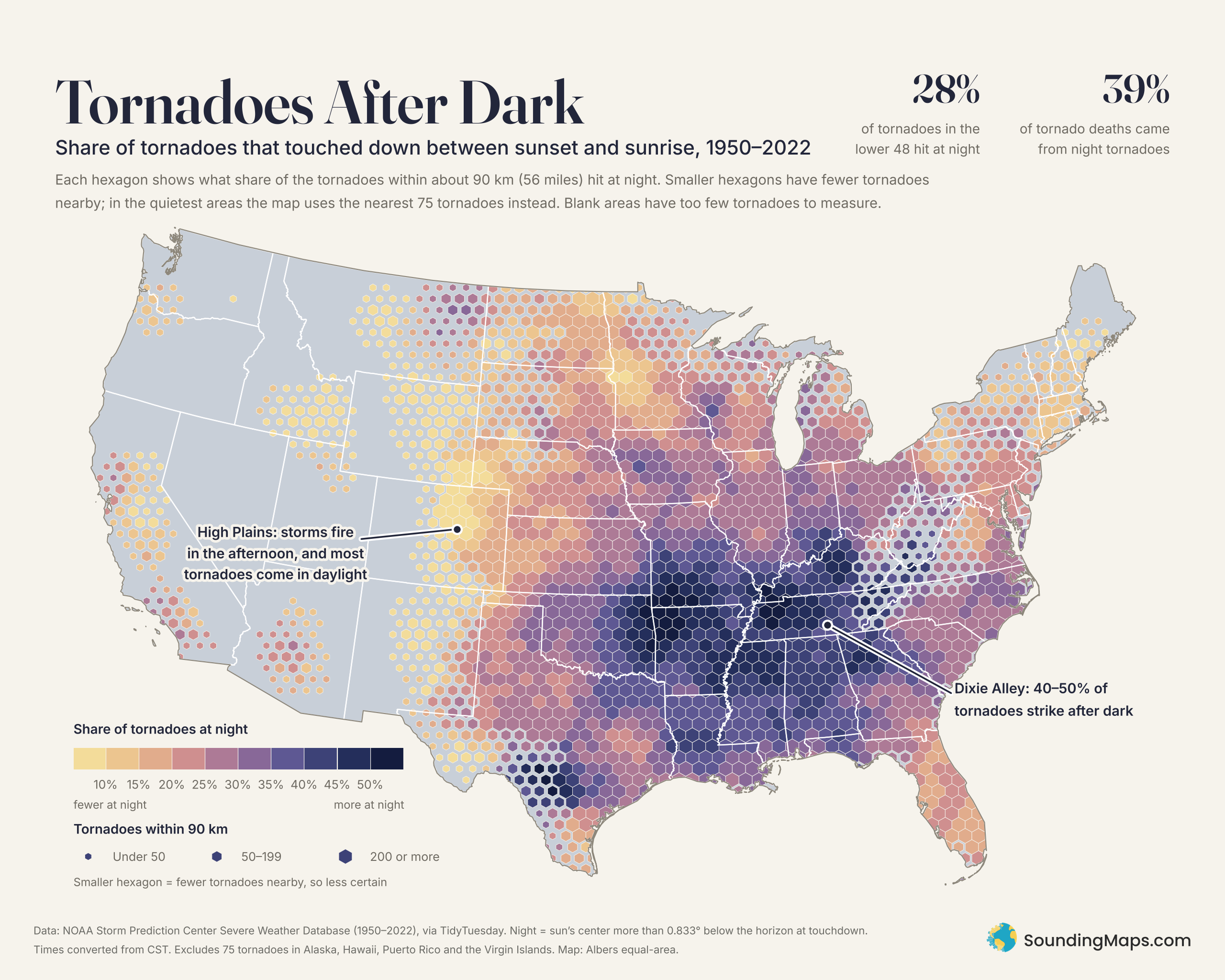
Picture a tornado and you probably picture it in daylight: a grey funnel over a Kansas wheat field, storm chasers parked on the shoulder. That picture is accurate for a lot of the Plains. It’s badly wrong for a big piece of the South.
We took every tornado in NOAA’s Storm Prediction Center database from 1950 through 2022, about 68,000 of them, and worked out whether the sun was up at the exact place and moment each one touched down. Then we mapped the share that came after dark.
What the map shows
Each hexagon is about 60 km across. Its color shows the night share of all tornadoes that touched down within 90 km of its center, or of the nearest 75 tornadoes in quiet areas. That smooths out the noise you’d get from tiny samples. Pale gold means almost all of them happened in daylight. Deep navy means a large share happened between sunset and sunrise. Hexagon size tells you how much to trust the color. Full-size hexagons have at least 200 tornadoes nearby. The smallest, mostly in the West and the Appalachians, have fewer than 50.
Nationally, 28% of tornadoes hit at night. That sounds like a minority, and it is. But those night tornadoes account for 39% of all tornado deaths in the record, and 42% of the tornadoes that killed at least one person.
Dixie Alley owns the night
The dark band running from eastern Oklahoma and Arkansas through Missouri’s Bootheel, west Tennessee, Mississippi, Alabama and Kentucky is the story of this map. Among states with at least 300 tornadoes on record:
- Tennessee: 46% at night
- Arkansas: 44%
- Kentucky: 43%
- Mississippi and Missouri: 40%
- Alabama: 40%
Compare that with the High Plains. In Colorado only 13% of tornadoes come after dark. In Wyoming it’s under 8%.
Why the split? Plains tornadoes mostly come from storms that fire in the heat of the afternoon and burn out after sunset. Across the Southeast, the strongest setups often arrive with powerful fall, winter and early-spring storm systems that don’t care what time it is. Moist Gulf air can keep fueling storms well into the night, and fast-moving lines of storms can produce tornadoes long after the sun goes down.
Winter tornadoes are night tornadoes
The season matters as much as the place. In the data, roughly half of all tornadoes in December and January happened at night, compared with under 20% in July. Long winter nights are part of it. The other part is the map itself: cold-season tornadoes cluster in the South and come with big storm systems, not afternoon heat.
Strong tornadoes skew dark, too. About 35% of tornadoes rated F3/EF3 or higher touched down at night, against 27% of weak F0–F1 and EF0–EF1 tornadoes.
Why night tornadoes are deadlier
A tornado at 3 a.m. is harder to see, harder to hear coming, and much more likely to catch people asleep. In the South, add hilly, forested terrain, rain-wrapped storms and a high share of manufactured homes, and getting people from warning to shelter gets harder.
That’s why forecasters’ advice for Southern storm nights is simple: have a way to get warnings that will wake you up.
A few things that surprised us
- The share isn’t shrinking. About 32% of tornadoes in the 1950s were at night, and 35% in 2020–2022. Better radar probably catches more night tornadoes than it used to, but either way, they haven’t become rarer.
- South Texas runs dark. The area west and south of San Antonio has one of the highest night shares in the country, mostly 40–55%. That’s based on a few hundred tornadoes, so it isn’t a small-sample fluke. Storms that form over the Mexican mountains in the evening and drift east overnight may be part of the reason.
The night count is probably too low
One caution before reading too much into any single number: night tornadoes are the ones most likely to have gone unrecorded. For much of this record, a tornado got logged only if someone saw it or found the damage, and a weak one at 2 a.m. in open country could easily go uncounted. Doppler radar, which went nationwide in the 1990s, catches far more of them. So the true night share is likely higher than this map shows, especially in older decades and rural areas. The geography should hold up, though: Dixie Alley stands out in every decade.
Methodology and sources
Data: NOAA Storm Prediction Center Severe Weather Database, tornado records 1950–2022, as packaged for TidyTuesday (May 2023). Each record is one tornado’s full track, including tornadoes that crossed state lines. We removed one exact duplicate and kept the 68,617 tornadoes that started in the lower 48, leaving out 75 in Alaska, Hawaii, Puerto Rico and the Virgin Islands, none of them fatal. Totals: 19,457 night tornadoes and 6,135 deaths, 2,392 of them in night tornadoes.
Night: For each tornado we calculated the sun’s elevation at the touchdown point and time. “Night” means the sun’s center was more than 0.833° below the horizon, the standard sunrise/sunset definition. SPC times are recorded in Central Standard Time year-round, so we converted them to UTC with a fixed six-hour offset rather than applying daylight saving time.
Mapping: We used tornado start points on an Albers equal-area projection, with a hexagon grid about 60 km across. Each hexagon’s value is the night share among tornadoes within 90 km of its center. Where fewer than 75 tornadoes fall in that radius, we used the nearest 75 instead, as long as they lie within 160 km. Otherwise the hexagon is left blank. Hexagons come in three sizes based on the number of tornadoes within 90 km: full size for 200 or more, three-quarter size for 50–199, and half size for fewer than 50. State figures use each tornado’s starting state.
Caveats: Older records, especially before the 1990s, miss many weak tornadoes. Night tornadoes were probably missed more often than daytime ones, so the night shares here are likely conservative. Some start times are estimates. Death counts are as reported in the SPC database.