
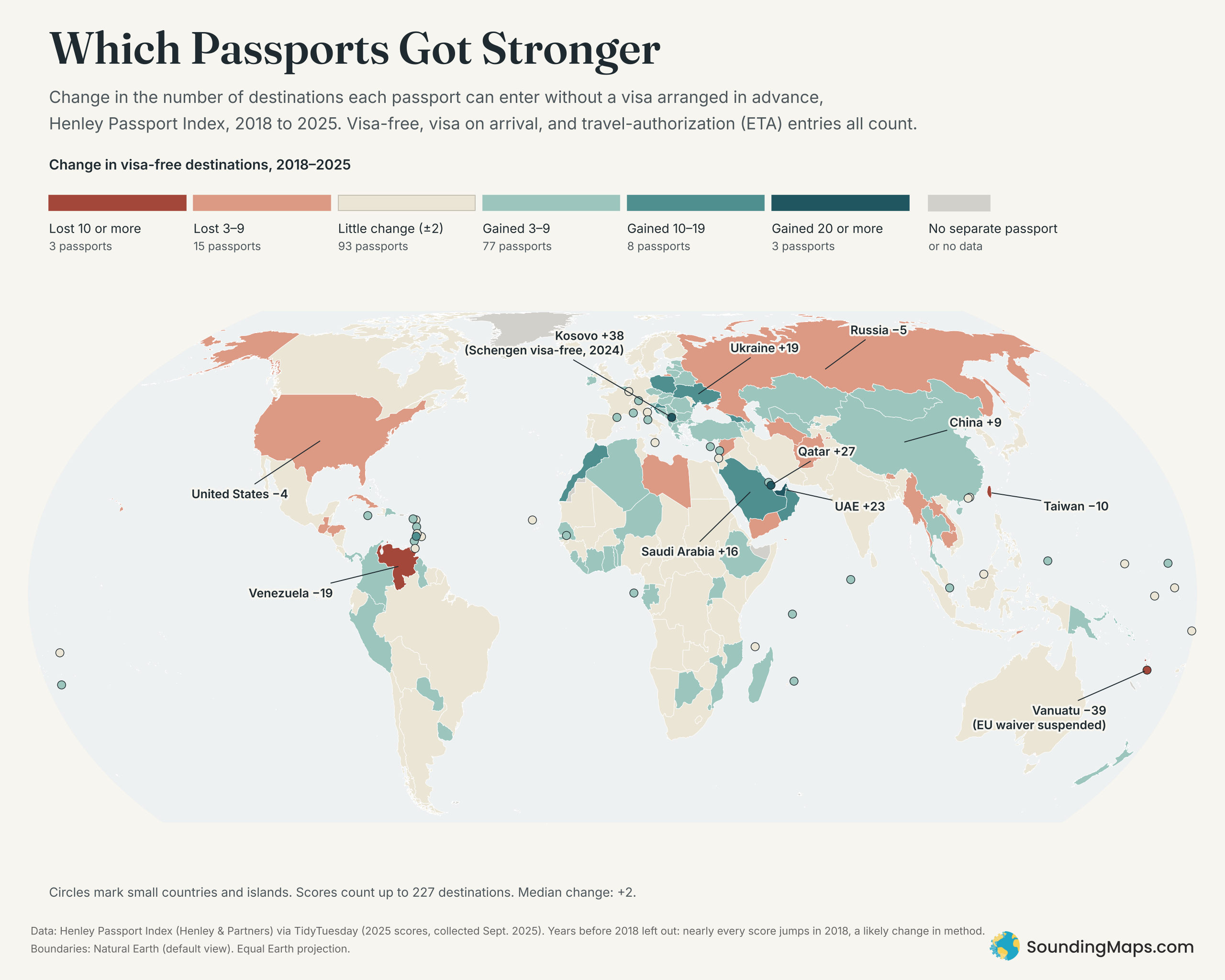
In 2018, a Kosovo passport opened 44 destinations without a visa arranged in advance. By 2025 it opened 82. No other passport gained as much.
This map shows that change for 199 passports. Colors show how many destinations each passport gained or lost on the Henley Passport Index, 2018 to 2025.
How the score works
Henley & Partners scores each passport against 227 destinations. A destination counts if its holders need no visa. Visas on arrival, visitor’s permits and electronic travel authorizations also count. Destinations requiring a visa or an e-visa approved before departure don’t count.
So a passport’s score depends on other governments. It rises when other countries drop visa rules for its holders. When they add them, it falls.
Most passports barely moved
The typical passport gained two destinations. Ninety-three passports changed by two or fewer, and 77 more gained between three and nine.
The world’s strongest passports were already near the top of the scale in 2018. Singapore went from 189 to 193. Japan stayed at 190. Germany rose by one, to 189. The United Kingdom stayed at 186.
The biggest gains
Three passports gained 20 or more destinations.
Kosovo gained 38. The European Union’s Schengen area dropped its visa requirement for Kosovo citizens on January 1, 2024. That decision alone opened dozens of countries.
Qatar gained 27, rising from 85 to 112. The United Arab Emirates gained 23, from 161 to 184, which put it among the world’s top passports. Saudi Arabia (+16) and Oman (+11) also rose.
Ukraine gained 19, from 128 to 147. Croatia gained 14. Its citizens have traveled to the United States without a visa since December 2021. Morocco (+12), Georgia (+11) and Poland (+10) round out the larger gains.
China gained nine, rising from 74 to 83.
The biggest losses
Eighteen passports lost three or more destinations.
Vanuatu fell furthest, from 129 to 90. The EU suspended visa-free travel for Vanuatu passport holders, citing the country’s sale of citizenship to foreign investors. Partial limits began in 2022, and the EU adopted a full suspension in December 2024.
Venezuela lost 19 destinations. Several countries in the Americas reintroduced visas for Venezuelans as millions left the country. Taiwan lost 10.
The United States slipped from 186 to 182, a loss of four. In mid-2025 that put the US passport 10th on Henley’s ranking. By October 2025 it had fallen out of the top 10 for the first time in the index’s 20 years. Russia lost five.
What the map leaves out
The score counts destinations equally. Access to a large neighbor counts the same as access to a small island state far away.
The map also measures only travel rules. Passport fees and waiting times for a passport aren’t part of it.
Methodology and sources
Henley & Partners publishes the index. TidyTuesday collected it from Henley’s public API in September 2025. Our “2025” value is the index as it stood then.
Henley’s yearly scores jump sharply for almost every country between 2017 and 2018. That looks like a change in method or destination coverage, not a real change in travel rules. We therefore compare 2018 with 2025 only. Earlier years are left out.
We matched countries to boundaries by two-letter ISO code. Namibia’s code, “NA”, needed care so the software didn’t read it as missing. Natural Earth gives France and Norway a placeholder code, so we matched them by name. Tuvalu, too small for the base map, appears as a circle. Circles also mark other small countries and islands. Territories without their own passport, such as Greenland and Puerto Rico, are grey.
Boundaries follow Natural Earth’s default view and do not imply a position on any disputed border.
Sources: Henley & Partners, Henley Passport Index; TidyTuesday, 2025-09-09; Natural Earth.